
Sextortion Scam
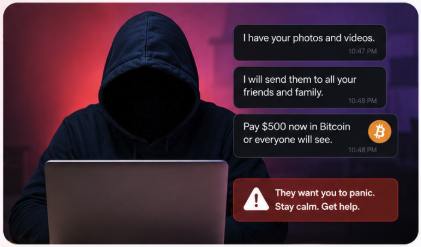
Sextortion is a form of online blackmail where criminals threaten to share private or intimate images, videos, messages or fake AI-generated content unless money is paid.
Key warning
Do not pay. Do not negotiate. Do not send more images.
Payment does not guarantee the threats will stop. Scammers often demand more once they know you are frightened.
Online blackmail alert
“Pay now or I’ll send this to everyone.”
Sextortion scammers rely on panic, shame and isolation. Their goal is to make you act before you speak to someone safe.
DO NOT Suffer in silence, your family and friend love you, you are never alone, just reach out and ask for help.
It might be embarrassing and devistation what you are going through, honestly once you speak up - people listen and can help.
.png)
.png)
.png)
What is sextortion?
Sextortion is online blackmail involving private, intimate or embarrassing material. A scammer may trick someone into sharing an image or video, steal content from an account, fake content using AI, or simply lie about having material.
The criminal then threatens to send it to friends, family, followers, school, work contacts or the wider internet unless money or another demand is met.
ScamAdvisory rule
Fear is the weapon. Isolation is the trap.
Why sextortion works
Sextortion works because it creates panic. The scammer wants the victim to feel trapped, ashamed and unable to ask for help.
The threat may feel very real, but paying does not give control back. It can prove to the criminal that pressure works and lead to repeated demands.
Common pressure tactics
- • Threatening to contact family, friends, school or work.
- • Showing screenshots of followers or contacts.
- • Demanding money through bank transfer, gift cards or crypto.
- • Setting a short deadline to create panic.
- • Asking for more images or more private information.
- • Claiming they have already sent the material when they may not have.
The threat may start in different ways
Sextortion can affect adults and young people. It can begin through dating apps, social media, gaming platforms, messaging apps, hacked accounts or fake profiles.
Direct message trap
A stranger quickly moves the conversation to private messages and becomes sexual or pressuring.
Fake profile
The scammer uses stolen photos, fake identities or AI-generated images to build trust.
AI-generated threat
The criminal may claim to have AI-edited or fake intimate images even if no real image was shared.
Account contact list pressure
They show names, followers or contacts to make the threat feel immediate and personal.
Payment demand
They demand money, gift cards, crypto or repeated payments to stop the threat.
Account takeover risk
They may ask for passwords, login codes, reset links or access to social media accounts.
Do not face the threat alone
Sextortion is designed to make you panic. The safest response is to stop, preserve what you safely can, report, and speak to someone you trust.
Risk level
Critical
Short deadline
They give you minutes or hours to pay before they “send everything”.
Secrecy pressure
They tell you not to contact police, family, friends, your bank or the platform.
Payment demand
They ask for bank transfer, gift cards, crypto, payment apps or more money after a first payment.
More image pressure
They ask for more photos, videos or private material to “prove” something or stop the threat.
Contact list screenshot
They show followers, family names, school, work contacts or social media friends.
Login or code request
They ask for passwords, two-factor codes, account access or reset links.
Stop replying. Do not pay. Get help.
Stop all communication with the offender. Do not argue, negotiate or explain.
Do not pay. Payment often leads to more demands, not safety.
Do not send more images, videos, documents, login codes or personal details.
Save messages, usernames, payment details and profile links if it is safe to do so. Do not forward intimate images to others.
Report the account to the platform and report the crime to the police. If a young person is involved, speak to a trusted adult and report through child protection routes.
If money has been sent, contact your bank immediately and explain that you are being blackmailed.
ScamAdvisory
Shame is how they control you. Support is how you break the threat.
Sextortion can feel frightening and isolating, but help is available. Do not pay, do not send more material, stop replying, report the account, and speak to someone you trust.