
Inheritance Scams
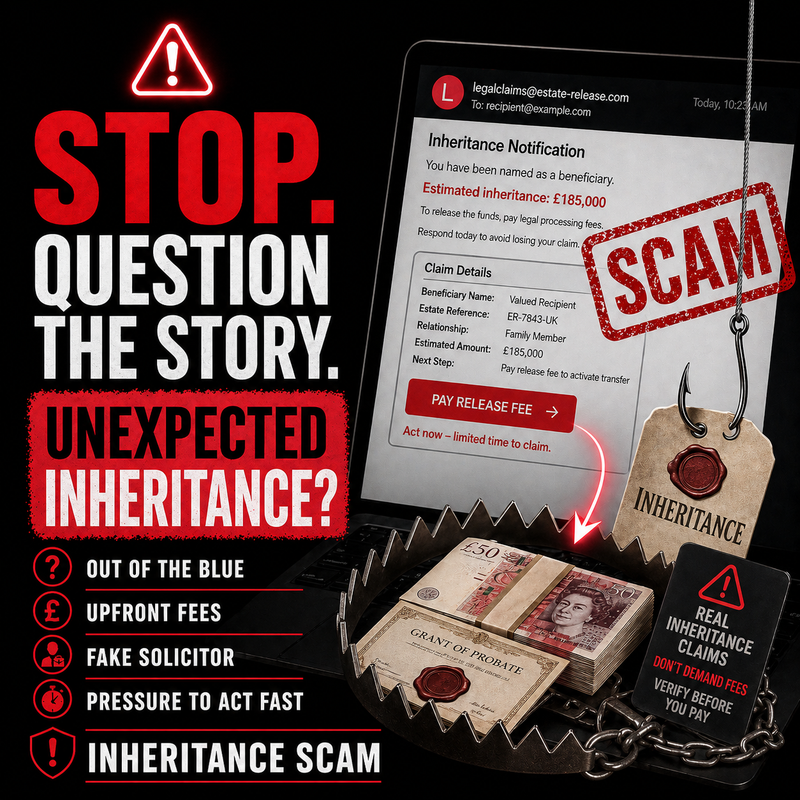
Inheritance scams trick people into believing they are entitled to money, property, assets or an overseas estate — but first they must pay fees, share documents or provide personal details.
Key warning
Be suspicious if you are told you have inherited money from someone you do not know.
Scammers often pretend to be lawyers, executors, bankers, officials or distant relatives and then ask for upfront fees, identity documents or bank details.
Unexpected fortune alert
“You are the beneficiary of an unclaimed estate.”
Inheritance scams create excitement, urgency and secrecy. The message may claim a wealthy person died overseas and you are the only surviving relative.
Common hook
“A distant relative left you millions, but you must act quickly.”
Common demand
“Pay legal, transfer, tax or certificate fees before funds can be released.”

What is an inheritance scam?
An inheritance scam is when criminals contact someone claiming they are entitled to money, property, valuables or assets from a deceased person’s estate.
The scammer may pretend to be a solicitor, barrister, banker, executor, government official or estate administrator. The victim is then asked to pay release fees, taxes, insurance, legal costs or transfer charges before the inheritance can be paid.
ScamAdvisory rule
If a stranger offers you a fortune, verify before you reply.
Why inheritance scams work
These scams exploit hope, curiosity and the possibility of unexpected wealth. The story may be made to sound official, legal and confidential.
Scammers often use formal language, fake documents, official-looking stamps, copied legal wording and impressive job titles to make the claim appear genuine.
Common storylines
- • A distant relative has died overseas.
- • You share a surname with a wealthy deceased person.
- • No other beneficiary can be found.
- • A lawyer needs your help to release dormant funds.
- • You must keep the inheritance confidential until processed.
The fortune comes with a catch
Most inheritance scams eventually lead to an upfront payment, personal document request, bank detail request or long-running advance-fee trap.
Advance-fee request
You must pay legal, tax, transfer, certificate, clearance or administration fees before receiving funds.
Fake lawyer or executor
The scammer pretends to be a legal professional managing an estate or dormant account.
Identity document request
You are asked to send passport scans, proof of address, bank details or other sensitive documents.
Overseas estate story
The inheritance is supposedly in another country, making it harder to verify independently.
Confidentiality pressure
You are told not to discuss the inheritance with family, banks, advisers or authorities.
Unexpected email or letter
The contact arrives out of the blue and claims you have been specially selected or traced.
Pause before you respond
Inheritance scams often start with excitement and then move toward pressure, secrecy and payment.
Risk level
High
Unexpected fortune
You are told you have inherited money from someone you do not know or cannot verify.
Upfront fees
You are asked to pay money before receiving the inheritance.
Document request
You are asked for passport scans, bank details, proof of address or personal information.
Urgency
You are told the claim will expire, be transferred or be lost unless you act immediately.
Secrecy
You are told to keep the matter private or avoid discussing it with anyone else.
Hard to verify
The solicitor, bank, firm, estate or country details are vague, inconsistent or difficult to confirm.
Do not pay fees to unlock a promised inheritance.
Do not reply with personal details, documents or bank information.
Do not pay release fees, legal fees, taxes, courier fees, transfer fees or certificate costs.
Search the law firm, bank, solicitor, email domain and phone number independently.
Speak to a trusted family member, solicitor, bank or adviser before taking any action.
If you have already sent money or documents, contact your bank and relevant platforms immediately.
ScamAdvisory
A fortune from a stranger is rarely what it appears to be.
Inheritance scams use hope, legal language and fake authority to create trust. Verify the claim, protect your documents, and never pay upfront fees to release promised funds.